
Few spirits draw as many parallels with wine as mezcal. Microclimates, varying soil types, plant ripeness, fermentation and distillation techniques, along with the producers’ influence, play immense roles in mezcal production. That’s in addition to the many types of agave used to make mezcal, much like the various grape varieties used in wine.
Imagine a world where all wine was Cabernet Sauvignon. This is the case with tequila, which is but one type of mezcal made exclusively from one variety of Agave tequilana, known as “Weber Azul” or “Blue Agave.” Mezcal, on the other hand, refers to any agave distillate, and can be made anywhere in Mexico, although there are some legal restrictions on which regions can label it as such. More than 20 very different agave varieties are widely used in broader mezcal production.
Just as Sauvignon Blanc or Syrah have wildly different expressions around the world, it’s hard to make blanket generalizations about mezcals based solely on agave type. The long roasting period before fermentation can introduce potentially dominant flavors of smoke and hardwood. Also, many commercial mezcals are diluted to a familiar strength of 38–42% alcohol by volume (abv) rather than the higher proof that most mezcaleros prefer.
“The grade of alcohol is very important,” says Temo García, a maestro mezcalero based in San Dionisio Ocotepec in Oaxaca state. “38 or 40% is very low, and it makes it hard to clearly distinguish the real essence of the maguey [agave]. We distill to at least 46% to bring out the best flavor.”
Agave variety, often listed on the bottle, is still usually the best place for consumers to distinguish among mezcals.
A note on nomenclature: “Common names” are just that, informal names that can vary by region and community. Like Zinfandel and Primitivo, the same agave can go by many names. However, the same name can also apply to very different agaves, depending on the region where it’s grown. In practice (if not on export labels), some mezcaleros skip common names altogether, referring to whatever agaves are available to them as simply criollo or campestre.
What about mezcal blends?
Blends of multiple agave types, called ensambles, are made for a variety of reasons. Rather than blending finished mezcals (the way winemakers blend different wines after fermentation), ensambles are usually cooked, fermented and distilled together, akin to a field blend wine. Because of consumer demand for single-variety mezcals, as well as and pride in their product, mezcal producers have little incentive to blend finished mezcals. Instead, the decision usually has more to do with availability and economics.
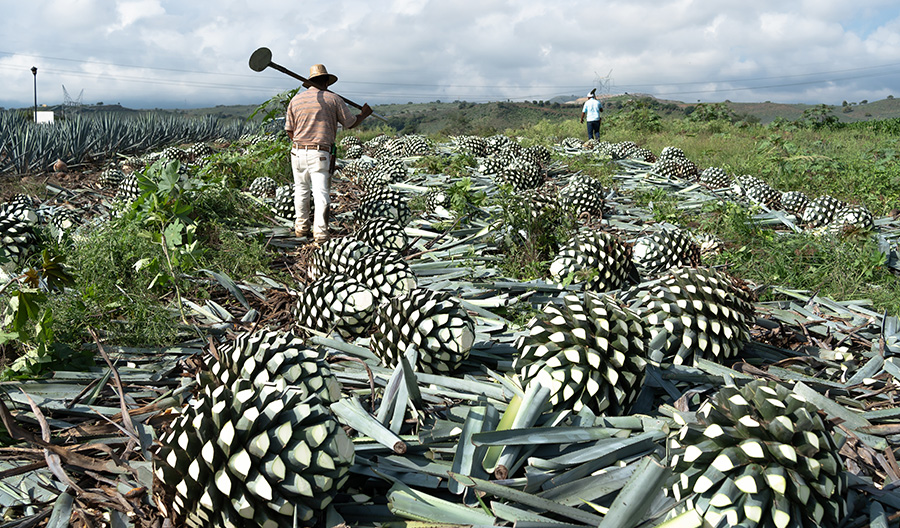
Before the piñas are crushed and fermented, they are roasted in an outdoor underground oven with large quantities of hardwood—not an inexpensive endeavor. It takes the same amount of firewood to bake three tons of agaves as it takes to bake eight tons. So sometimes palenqueros will acquire whatever they can to fill the oven and decide after baking whether to make a blend or to segregate the species. Sometimes there’s only enough of one species to fill a third of a fermentation vat, so it’s simply not worth it to segregate.
For those with an ample agave supply, the decision is less about agave affinities than pairing an especially flavorful variety with a high-yielding variety like espadín. This is often the case with tepeztate. A palenquero might mix, for example, 70% tepeztate with 30% espadín, yielding the tepeztate flavor but the high yield of the espadín enables the palenquero to sell at a more reasonable price.
Still, some mezcal producers will do the same blend repeatedly. Some palenqueros will blend two to five species and love the result, and keep doing it that way. They also might find that buyers love a particular mix, and that motivates them to keep doing it.